

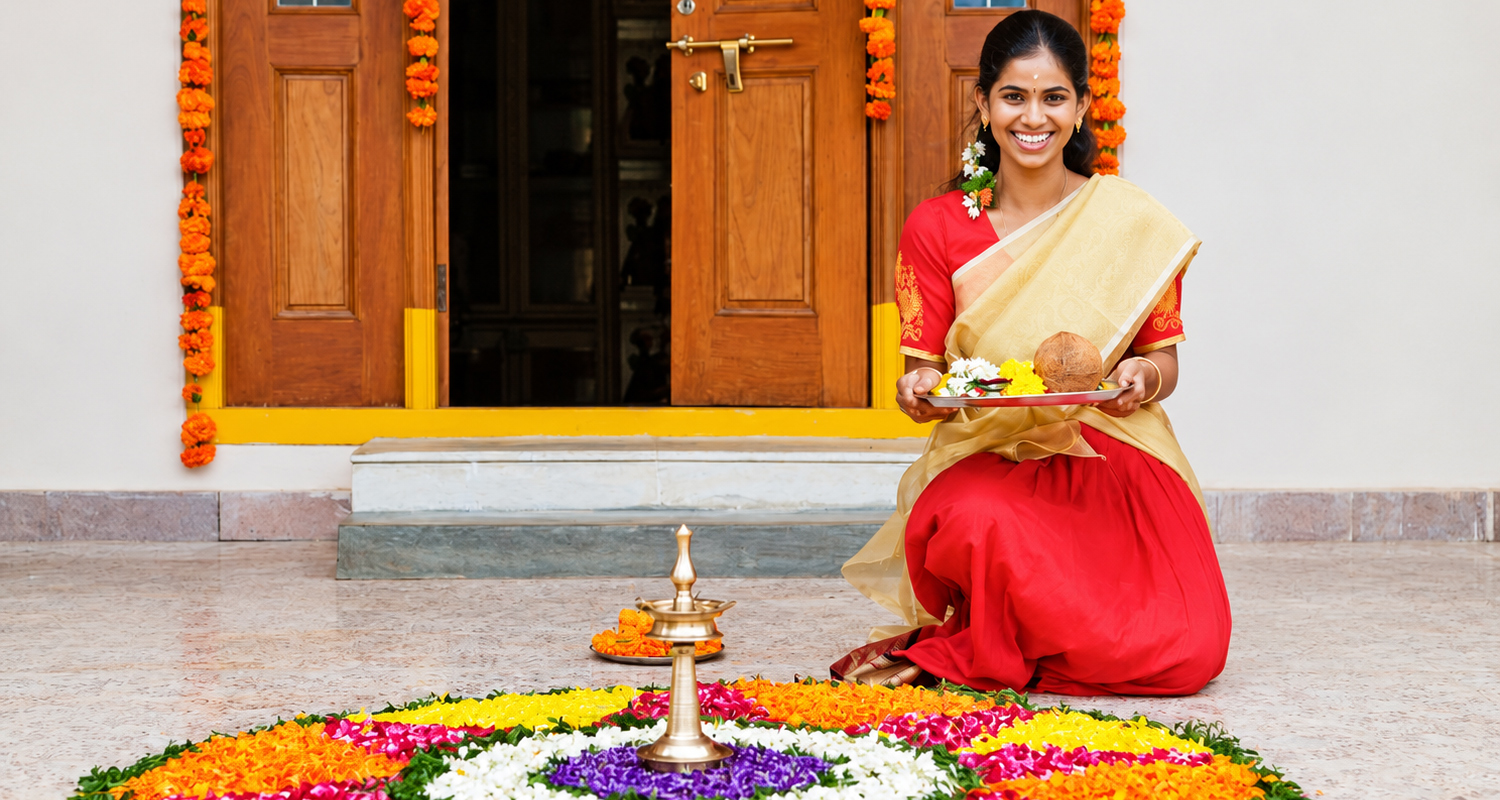
Chennai – Mahabalipuram – Pondicherry – Kumbakonam – Tanjore – Trichy – Madurai –Periyar – Backwater – Cochin
11 Nights / 12 Days
Day 01: Arrive Chennai
Arrive in Chennai. On arrival, you will be greeted and assisted by our representative and transferred to the hotel.
(Check in time is 1400 Hrs)
CHENNAI – Formerly called Madras, it is the capital city of the Indian state of Tamil Nadu. This metropolis is often called the cultural capital of India for its deep-rooted traditions and long heritage. Spread over 200 square kilometers with the Bay of Bengal on the east, the city is the gateway to the rest of South India. Modern Chennai grew out of a small village when in 1639 a fishing hamlet called “Madraspatnam” was selected by early English merchants of the East India Company as a site for the settlement. The city is popular for its numerous tourist destinations including beaches, temples, forts, palaces along with many colourful festivals that attract tourists from all parts of the country. The city presents a culture that is totally different from North India and represents a lifestyle that is a perfect blend of traditional and modern India.
Late afternoon, enjoy the sightseeing of Chennai.
St. Andrew’s Kirche (The Kirk) -Consecrated in 1821, it is one of the oldest churches in the region that was built to serve the Scottish community. It was modelled on the lines of London’s St. Martin-in-the-Fields church and is one of the many fascinating colonial-era landmarks with Corinthian-style columns, limestone stucco work, elaborate stained-glass windows and elegant décor.
Santhome Cathedral is a historical ancient pilgrim centre, built during the period 14-15th century AD, by the Portuguese. This Cathedral, near Chennai beach, got its name from St. Thomas, the doubting disciple of Jesus Christ. A museum is located in the grounds nearby and the main attraction of the museum is a 16th-century map of South Asia. The Cathedral is one of the most prominent attractions in Chennai.
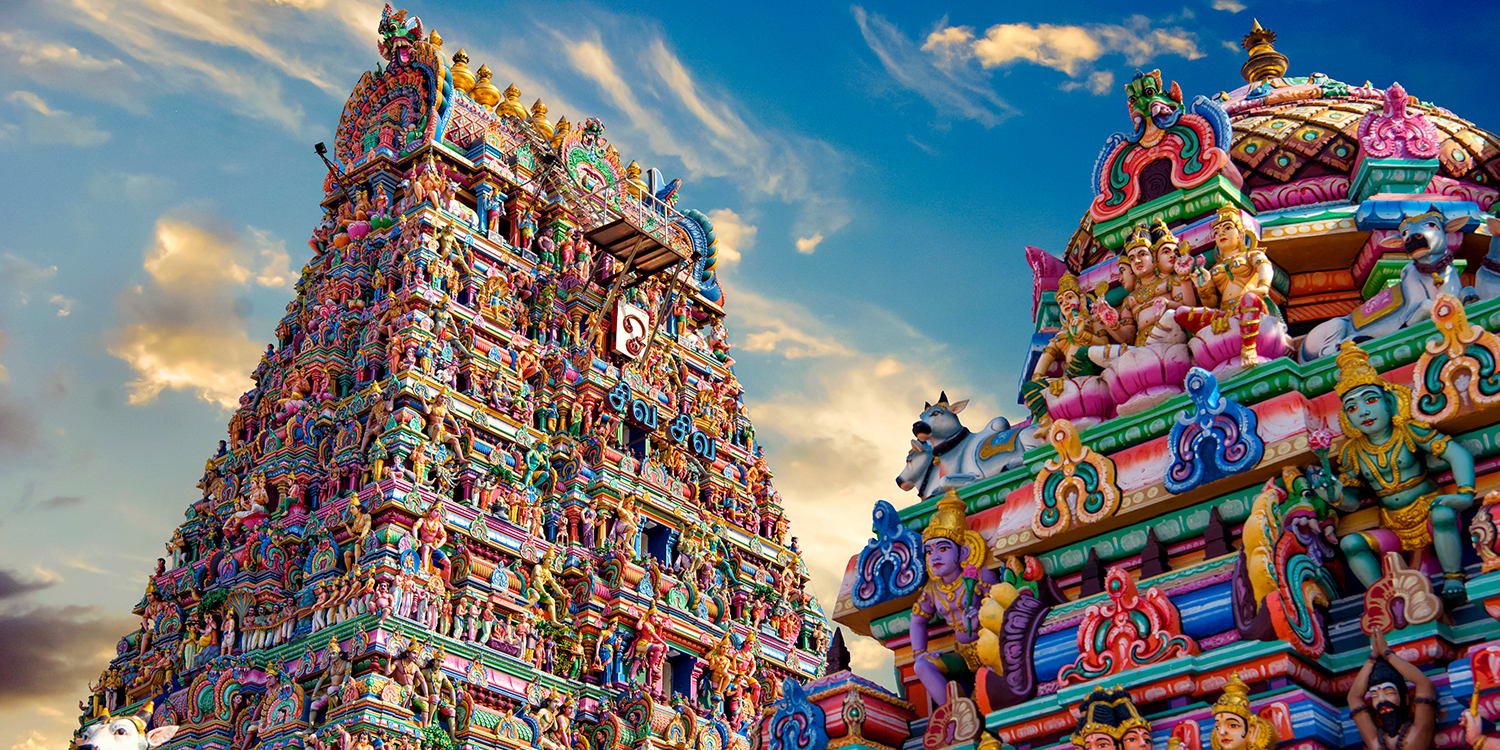
Visit Kapaleshvara Temple , an ancient Shiva temple, is the biggest temple in Chennai. A masterpiece of Dravidian style, it displays the architectural elements – gopurams, mandapams, and a tank. There are some fragmentary inscriptions dating back to 1250 AD, though the architecture and structure of this temple are more related to the culture that prevailed in the 16th century when Vijay Nagar kings refurbished it. As per the tradition, Goddess Karpagambal is offered a garland made of gold coins named kaasu maala on the ritual of Friday worship.
In the evening, spend some time at Marina Beach.
Marina Beach: Covered with glittering golden sand and a clear strip of the blue sea, Marina Beach is among the most magnificent beaches in India. Sited at Kamarajar Salai Road, at a distance of aprox. 3 kms from Chennai, the capital city of Tamil Nadu, it is said to be the second longest urban beach in the world, extending to a length of 13 km. Athough there exist several other longer beaches in the other parts of the world, however unlike most beaches, Marina is a natural sandy urban beach helping it earn the title. Here, the experience of watching the sunrise and sunset is at its captivating best and breathtaking.
Overnight at the hotel
Day 02: Chennai / Mahabalipuram (Approx. 60 kms / 01 hrs) / Pondicherry (Approx. 100 kms / 02 hrs)
After breakfast, drive to Mahabalipuram.
MAHABALIPURAM – Also known as Mamallapuram, it is a 7th century coastal town located about 60 km from Chennai. Mahabalipuram name originated from Mamallapuram, where ‘mamall’ means excellent wrestler and was a name offered to King Narasimha Varman I. Mahabalipuram is a UNESCO world heritage site, which has various historical monuments dating back to period between 7th to 9th centuries. It is home to various rocks cut monuments that stand as an example of the Dravidian architecture. Mahabalipuram is a perfect treat for tourists with its long stretches of sea coast and some of the amazing carved granite structures with Dravidian architecture.
On arrival in Mahabalipuram, enjoy visit of Mahabalipuram including following:
Five Rathas – The Five Rathas, also known as Panch Rathas, is a set of rock temples. They are excellent examples of the evolution of Dravidian style architecture. These temples are built in the same shape as pagodas, and greatly resemble Buddhist shrines and monasteries. The rathas are associated with the great epic Mahabharata. These are the architectural prototypes demonstrate the imposing gopurams and Vimanas; multi pillared halls and sculptured walls, which dominate the landscape of Tamil Nadu.
Arjuna’s Penance – The Arjuna’s penance is one of the most famous stone carvings at Mahabalipuram. It is an enormous relief made on two massive boulders. One of the biggest open-air rock canvases in the world, the Arjuna’s penance is 31m long and 9m high. There are many schools of thoughts over the theme of Arjuna’s penance. One believes that the sculpture shows Arjuna undertaking a penance to obtain a rare weapon against his enemies; the other School believes that it portrays the legend of the River Ganges’s descent to earth. Whatever the reasons, Arjuna penance remains one of the most beautifully carved structures. Arjuna’s Penance has over 100 figures of gods and semi divine creatures, birds and beasts, man and saint.
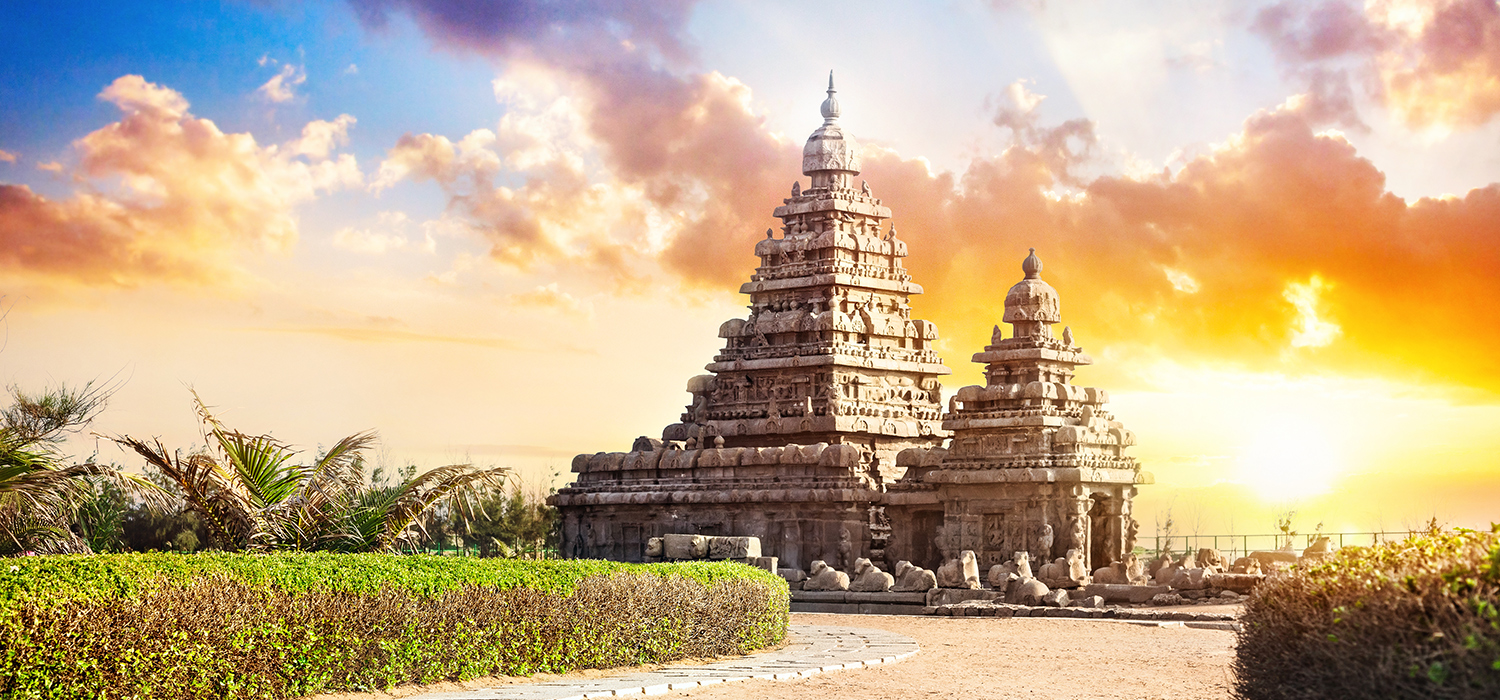
Shore Temple – This beautiful and romantic temple, ravaged by wind and sea, represents the final phase of Pallavas art and it was built in the late 7th century during the reign of Rajasimha. It is believed that at one point in time there were seven such temples, six of them were victims to the natural elements of erosion. This temple has three shrines; one dedicated to Lord Vishnu and the other two to Lord Shiva. The frothy waves form a striking backdrop to the temple, protected by rows of rock-carved bulls. The most unique feature of the temple is that it houses shrines to both Lord Shiva and Lord Vishnu.
Mandapams – In Mahabalipuram, there are eight Mandapams (shallow, rock-cut halls) scattered over the main hill, two of which have been left unfinished. They are mainly of interest for their internal figure sculptures. One of the earliest rock-cut temples is the Krishna Mandapam. It features carvings of a pastoral scene showing Krishna lifting up the Govardhana Mountain to protect his kinsfolk from the wrath of Indra. On the hill rests a dangerously balanced boulder named Krishna’s Butterball after his legendary affinity for fresh butter.
Later continue your drive to Pondicherry, which was a former French colony, it still has Portuguese culture intact in the city. Pondicherry is also a sacred place where St. Agasthaya and Shri Aurobindo settled down and sought peace.
On arrival in Pondicherry, transfer to the hotel.
Overnight at the hotel
Day 03: Pondicherry
After breakfast, enjoy excursion to Auroville – Located about 10 kms north of Pondicherry, Auroville is described as “the City of Tomorrow”. Auroville was envisioned as a Universal Town, where people from different nationalities, faiths and beliefs could live in peace and harmony in Auroville attractions. Auroville Region is an ideal township devoted to an experiment in human unity. The purpose of Auroville is to realize human unity in diversity. It is recognized as the first endorsed ongoing experiment in human unity and transformation of consciousness in Auroville attractions. (It remains closed from 1230 hrs till 1400 hrs).
Return to the Hotel.
Afternoon visit the Sri Aurobindo Ashram – Founded by Sri Aurobindo way back in November 1926. Initially the Ashram comprised of only 24 disciples. The Sri Aurobindo Ashram in Pondicherry has come a long way from its initial days of inception. It now features among the major places of tourist interest in Pondicherry. Sri Aurobindo Ashram in Pondicherry today is a large institution that has its extensions in almost all the major cities all over the world. It offers many charitable benefits to the area, including free medical amenities and a publishing house.
Heritage walk in French quarters of Pondicherry. (Duration: Approx 02 hrs)
This walk is through the French quarters and will take approx 02 Hours. The former French colony retains the attributes and beauty of French architecture along the White Town (French Quarter). This area includes French houses, Government buildings, café etc. This walk will cover the various lesser known, interesting buildings & monuments. Walk will include Ganesha Temple (a very beautiful small temple, one of its own kinds), Ayi Mandapam (probably the only monument in the world dedicated to a harlot), French War Memorial, Gandhi Statue, Ashram Dining Room, Old Light House and many more.
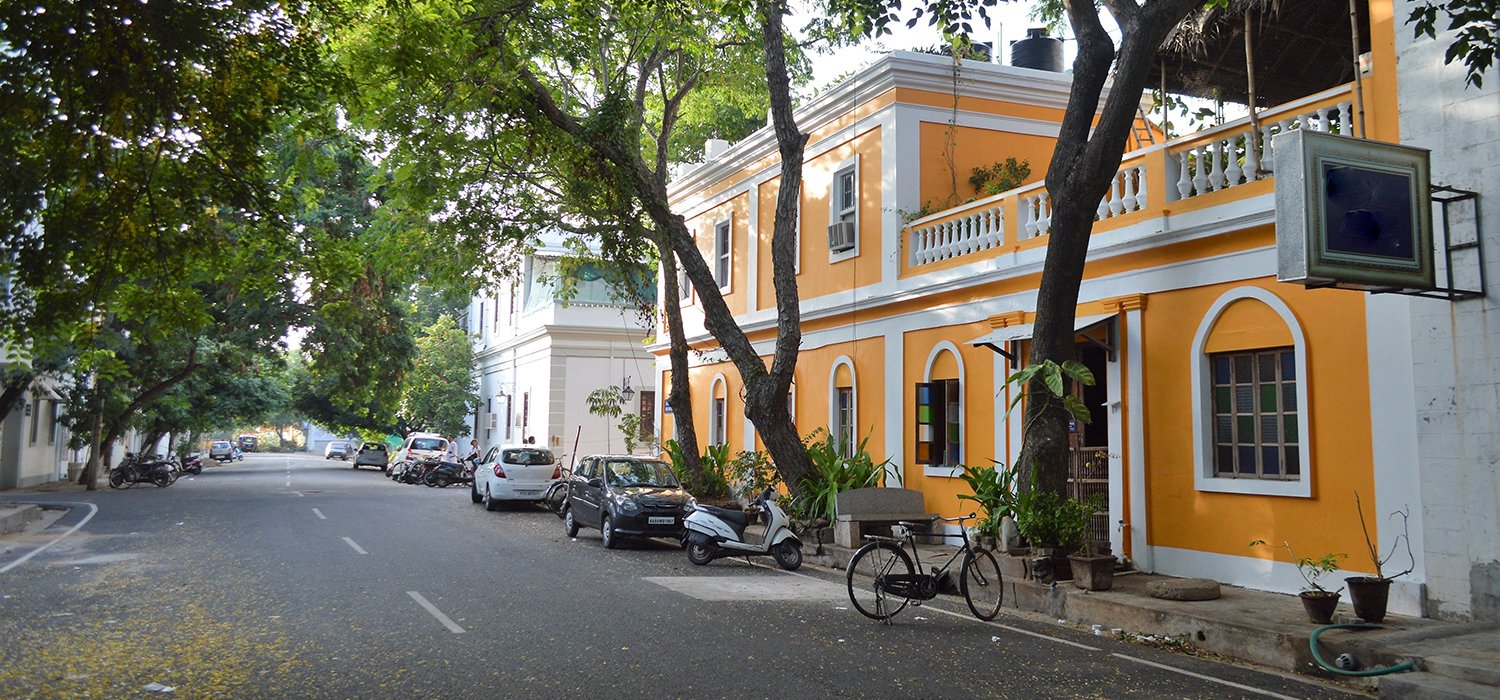
We will walk around the town passing by colonial buildings having a lush green gardens and nice outlining of Bougainvillea flowers which adds to the beauty of Streets. Pass by some of the important buildings like Our Lady of Angels Church which is the fourth oldest Church, Mayor House, French War Memorial, Mahatma Gandhi Statue, Aayi Mandapam built by Napoleon III, Legislative Building, Raj Nivas; the current residence for City’s Governor, Puducherry Museum from outside and will end our walk with the visit to Aurobindo Ashram.
Overnight at the hotel.
Day 04: Pondicherry / Kumbakonam (Approx. 145 kms / 04 hrs)
After breakfast, drive to Kumbakonam.
After breakfast drive to Kumbakonam by Surface, on the way visit the Nataraj Temple – The Chidambaram Nataraja Temple is an excellent example, of unique amalgamation, of a number of architectural styles. The innermost sanctum has idols of Lord Shiva and Goddess Parvati. The Chitsabha inside the temple is an interesting piece of architecture. The most fascinating and important shrine located inside the Chidambaram Nataraja Temple is that of Govindaraja Perumal. There are five halls in the temples including Nritha Sabha, Hall of Immortal Dance. Sivakamiamman Temple, the Sivaganga Tank and the thousand pillar hall are also important features of the temple.IMP: It remains closed from 1200 hrs till 1600 hrs.
Drive further and enroute visit the Gangaikondacholapuram Temple (without guide) – Gangaikonda Cholapuram was the capital of the Cholas during the 11th century. It was during the reign of Rajendra Chola I, Gangaikonda Cholapuram reached the pinnacle of its fame. The name Gangaikonda Cholapuram means the city of the Chola King who captured the Ganges. The prime attraction of this place is the great temple of Lord Shiva. This temple is similar to the Brihadishwara temple at Thanjavur. It is just behind the Thanjavur temple in its monumental nature and designs. There is a structure of a Vimana which holds the visitor’s sight. It resembles the pyramidal tower in Thanjavur temple. IMP: It remains closed from 1200 hrs till 1600 hrs.
Continue drive to Kumbakonam.
KUMBAKONAM – The name “Kumbakonam”, roughly translated in English as the “POT”s angle”, is believed to be an allusion to the mythical pot, the Sanskrit kumbha of the Hindu god Brahma, which according to Hindu legend contained the seed of all living beings on earth. The kumbha is believed to have been displaced by a deluge and ultimately came to rest at the spot where the town of Kumbakonam now stands.
On arrival in Kumbakonam, transfer to hotel.
Overnight at the hotel.
Day 05: Kumbakonam
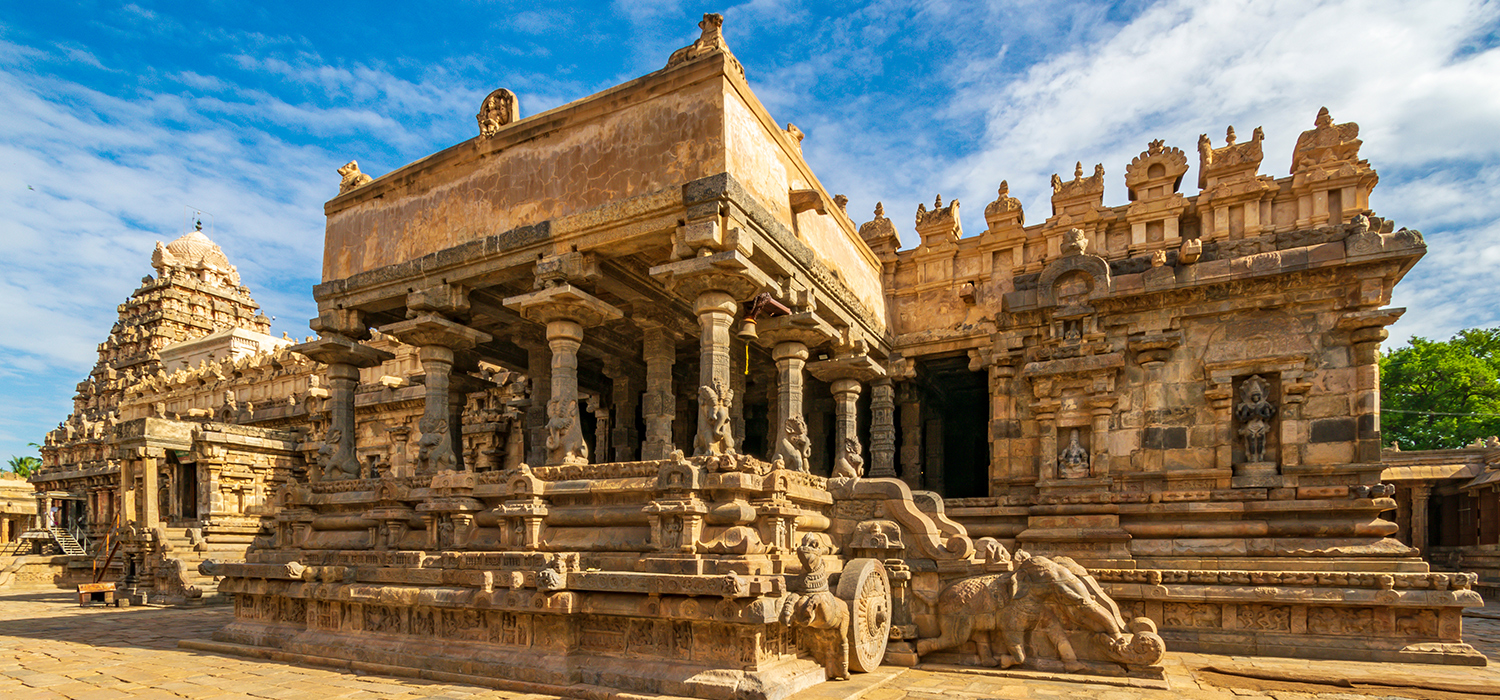
After breakfast, Visit Dharasuram Airavateshwara Temple and the Puja Ceremony – A ‘Sculptor’s dream in stone’, musical pillars, mandapam in the shape of a chariot, a wealth of sculpture and painting are synonymous with Airavateshvara Temple in Darasuram. The temple dedicated to Lord Shiva, is a well-preserved example of 12th century Chola architecture. You can participate in the Puja ceremony to experience the temple’s spiritual ambiance firsthand. (It remains closed from 1200 hrs till 1600 hrs).
In Dharasuram, we will organize a visit to the village, home to about 200 houses engaged in the traditional art of silk weaving. During the visit, you will have the opportunity to explore a typical house where the intricate process of silk weaving is carried out. Witness the craftsmanship firsthand as skilled artisans work on handlooms, creating beautiful, vibrant silk sarees with detailed patterns and rich textures. This experience will provide a unique insight into the time-honoured weaving traditions that have been passed down through generations in this quaint village.
Later enjoy bullock cart through village – An evening ride on the bullock cart, piercing thru the little village, and one could see both sides of lush and green an paddy fields, and the ancient historic two temple in between (Chathurkala Bhairavar & Karkadeshwar-) which is several centuries beyond one’s imagination. A Hot Kumbakonam Degree Filter Coffee will make guest sit and watch for many.
Overnight at the hotel.
Day 06: Kumbakonam / Thanjavur / Trichy / Madurai (237 Kms around 06 hrs drive)
After breakfast, drive to Thanjavur
THANJAVUR – The name Thanjavur is derived from “Tanjan”, a legendary demon in Hindu mythology. Thanjavur as the British called it is extremely fertile, prosperous and scenic; it was the natural choice for capital city of one of the greatest empires of the south. Now a small city in the state of Tamil Nadu, it rose to glory during the Chola period from the 10th century to the 14th, when it came to be the centre of art and education. The Cholas built extensively during this period and 74 of their temples are still standing.
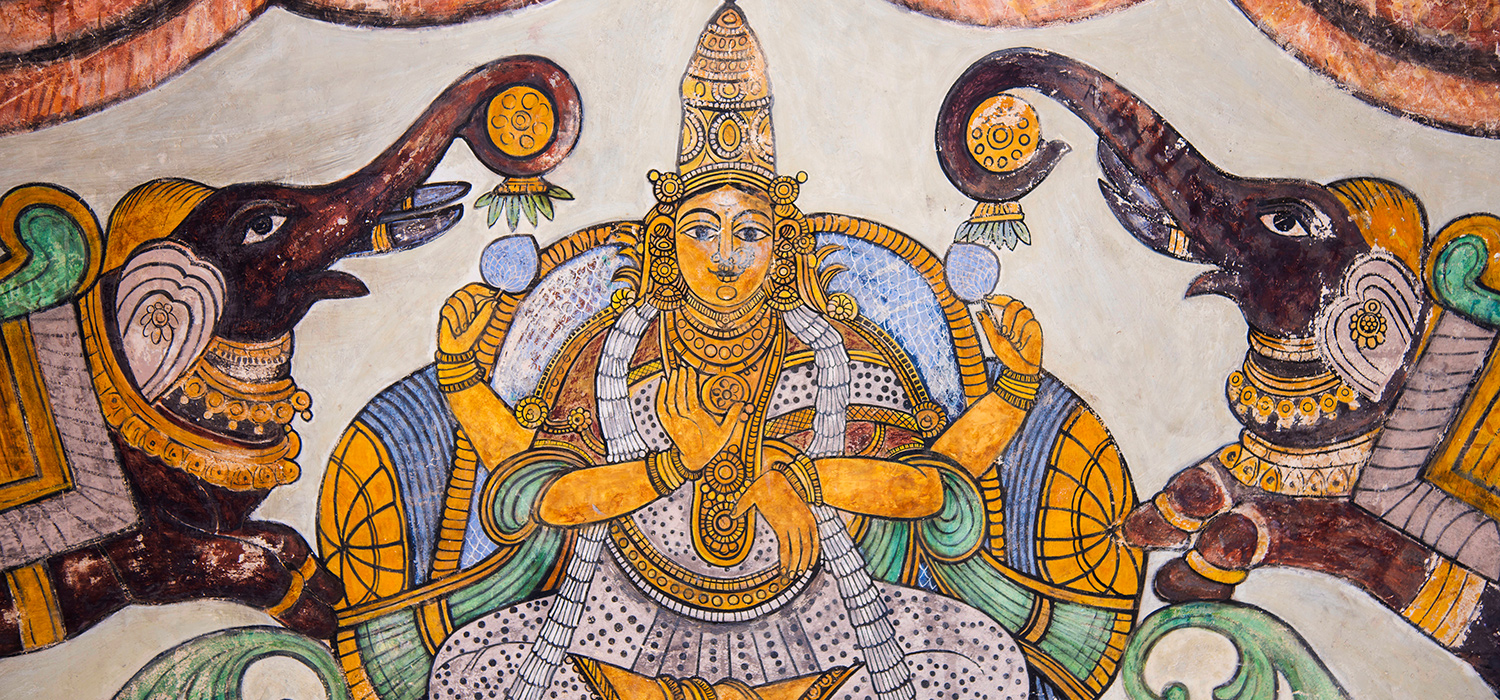
On arrival, visit the Brihadeshwara Temple Built by great Chola king in the 10th century it is an outstanding example of Chola architecture and is listed in world heritage. On the top of the apex of 63 meters high, a dome is said to be constructed from a single piece of granite, weighing an estimated 81 tones. The dome was hauled into place along a 6 km earthwork ramp in a manner similar to the one used by the Egyptian Pyramids. The temple has been the sense of continuous worship for over thousand years. Only Hindus are allowed inside. IMP: It remains closed from 1200 to 1600 hrs.
Later drive to Trichy and visits Sri Rangnathaswamy Temple – This superb temple complex at Srirangam, about three km from the Rock Fort, is surrounded by seven concentric walls with 21 gopurams and is probably the largest in India. Most of the temple complex date from 14th to 17th centuries, and many people were involved in its construction, including the Cheras, Pandyas, Cholas, Hoysalas, and Vijayanagars. The largest gopuram, in the first wall on the southern side, was completed in 1987 and measures an astounding 73m in height. The temple complex is very well preserved, with excellent carvings throughout. With numerous shrines dedicated to various gods, the main temple is dedicated to Lord Vishnu. It is said that even Muslims used to pray here after the fall of the Vijayanagar Empire.
After visit, drive to Madurai
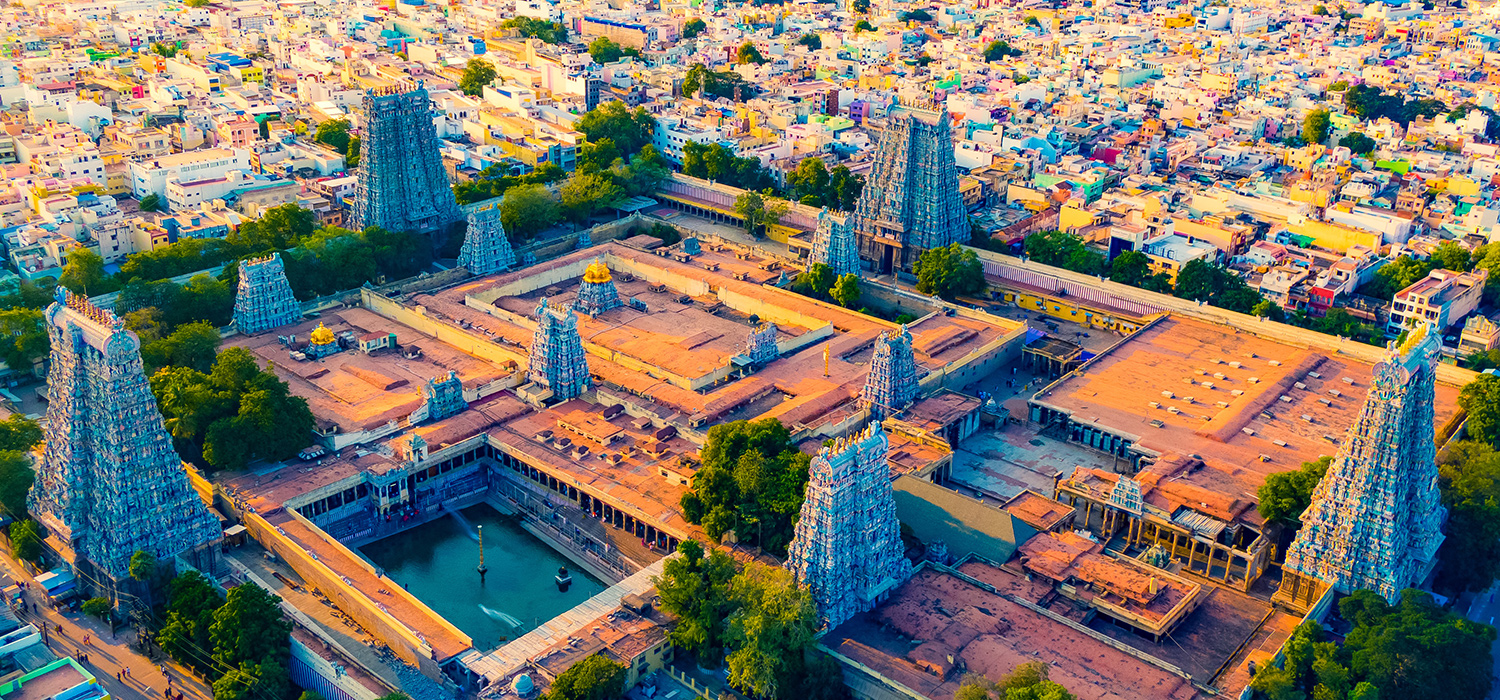
According to Hindu mythology, the city of Madurai in the Indian state of Tamil Nadu was created when King Kulasekhara Pandya dreamt of drops of madhu or honey dripping down from the matted locks of the Hindu god Shiva. The place where the madhu fell was called Madhurpuri, which eventually became Madurai. Located along the banks of Vaigai River, Madurai is also called the “Athens of the East”. A place of great historical and cultural importance because of its temples, monuments, and ancient cultural wonders, Madurai has earned several sobriquets such as “Temple City”, “The Cultural Capital of Tamil Nadu”, “The City of Jasmine”, and “The City that Never Sleeps”.
On arrival in Madurai, transfer to hotel.
Overnight at the hotel.
Day 07: Madurai
Early in the morning drive from the hotel to the East Tower of the Meenakshi Temple for a walk around the Town – While the folks are busy exploring tourist sites, we will walk through the Alleys of Madurai very early in the morning to discover the local life of the oldest city of South India. During our walk, we will see how people start their day with variety of activities. Housewives drawing Koalam in front of their homes to bring prosperity, milking of cows, street vendors selling daily need vegetable, herbs and food is a treat to watch. Wholesale market, where fruits and vegetables from different parts of South India are bought and sold can be seen during the walk. Here one gets to see different varieties of fruits and Vegetables. We will also pass through some sandal wood shops and finally end our walk by climbing up to one of the tallest buildings in the vicinity to get a panoramic view of Madurai. During the walk you will also get to taste some local food (Tea / Snacks etc) and finally the walk will end with a traditional South Indian breakfast.
After the walk drive back to the hotel and enjoy a late breakfast.
After breakfast enjoy visit of Madurai including following:
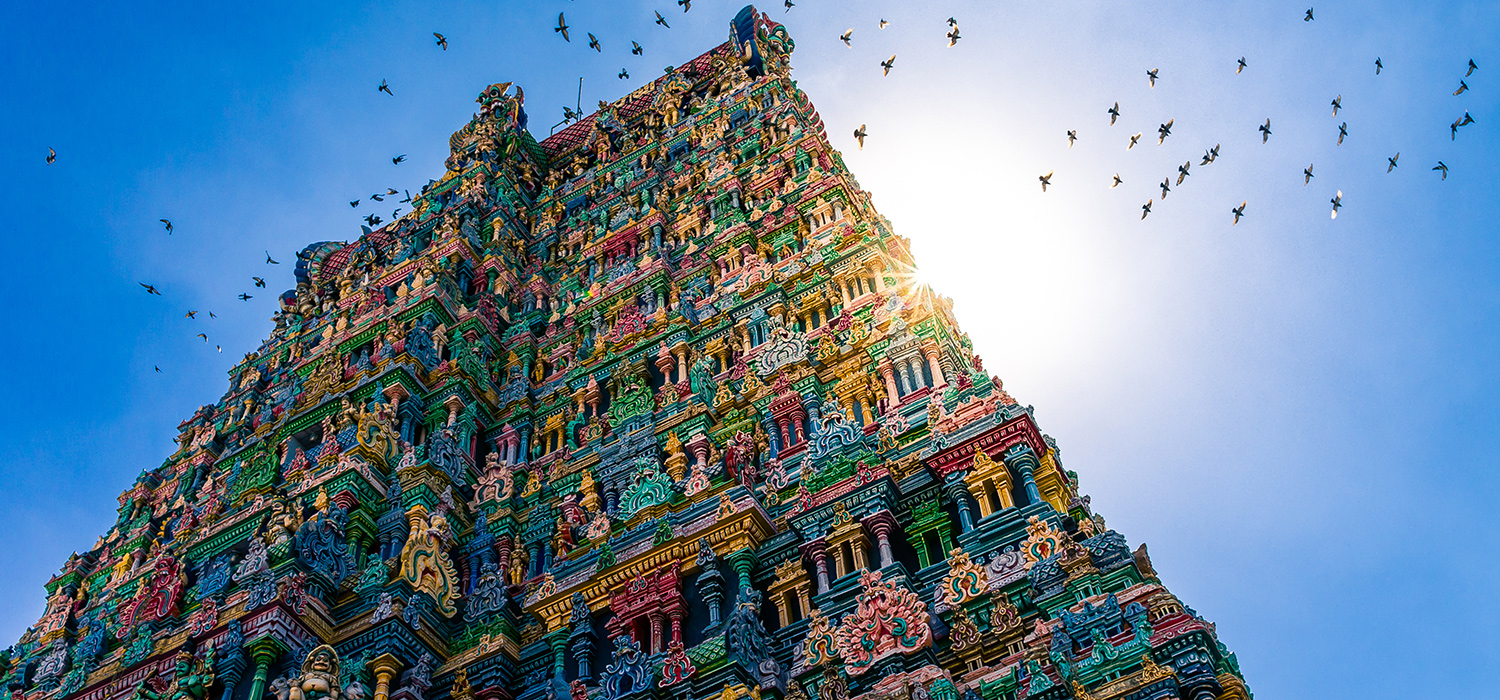
Meenakshi Temple – This temple is nearly 2000 years old placed in the heart of the old town-a splendid example of Dravidian architecture. The present temple was designed in 1560 by Vishwanatha Nayak and subsequently built during the reign of Tirumalai Nayak. There are four entrances to the temple with an area of six hectares. Each of its 12 towers has the height of 45 to 50 meters. The Potrama Raikulam or the Golden Lotus Tank is the place where the Tamil literacy society, called Sangam used to meet to decide the merits of the work presented to them. The temple museum has 985 richly carved pillars and each one surpasses the other in beauty. (It remains closed from 1200 hrs till 1530 hrs).
Overnight at the hotel
Day 08: Madurai / Periyar (142 Kms around 04½ hrs drive)
After breakfast drive to Periyar by Surface.
Periyar – Situated in the hills of the Western Ghats, Periyar National Park is well known for being a tiger and elephant reserve. At the heart of the park is the 5,500 hectare Periyar Lake which was formed when the Mullaperiyar Dam was erected in 1895. The waters submerged the low-lying forest whose dead tree trunks still jut out of the waters. There are marshy grasslands along the edges of the lake that form the perfect habitat for the rich biodiversity of the park, especially large mammals like tigers. Providing excellent camouflage and succulent shoots and grasses, Periyar is a paradise for elephants, which can often be sighted frolicking in the waters of the lake.
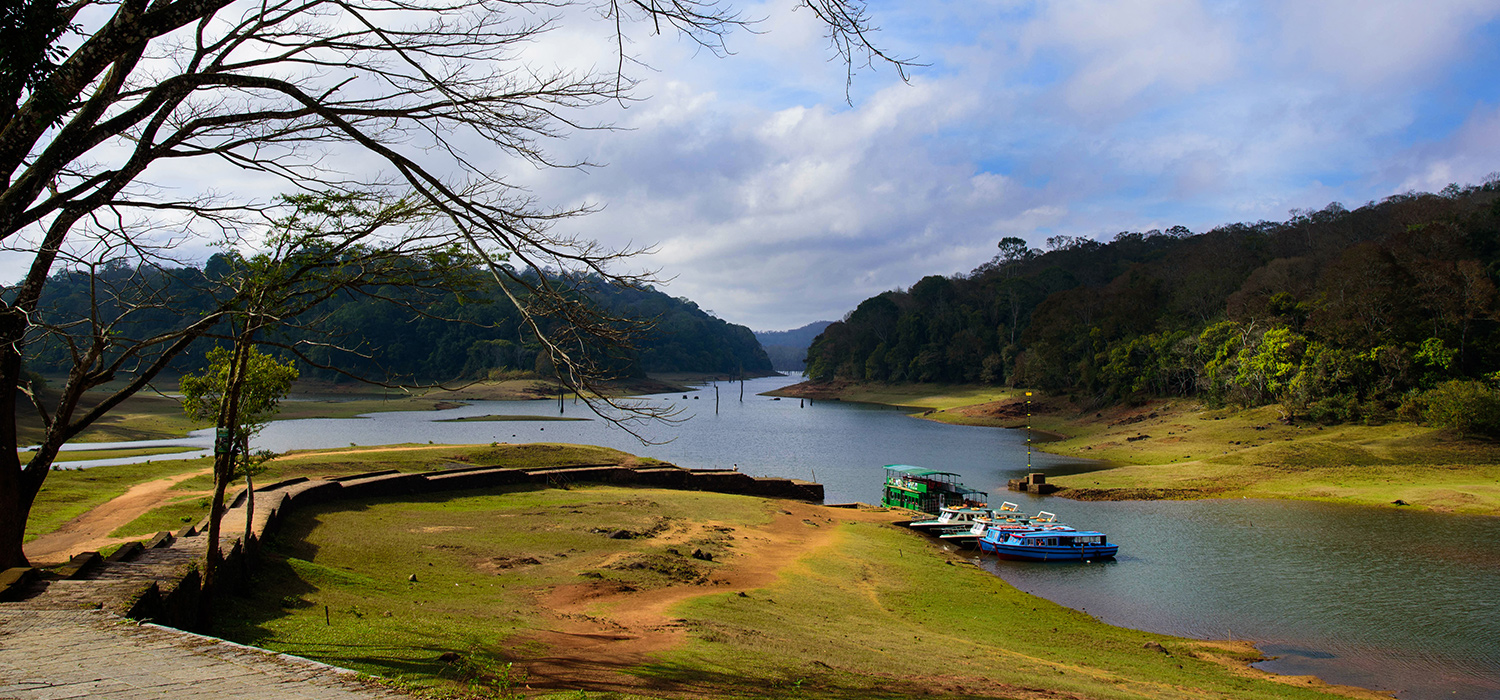
On arrival in Periyar, transfer to hotel.
Later, enjoy a Scenic jeep ride tour – a two-hour activity will take you through green vegetation to several points from where you can have glimpses of the Western Ghats of Kerala and over the plains of Tamil Nādu. The Western Ghats are internationally recognized as a region of immense global importance for the conservation of biological diversity, besides containing areas of high geological, cultural, and aesthetic values.
In the evening enjoy Kalaripayattu show – Enjoy Kalaripayattu performance at a local theatre. The word Kalari meaning battlefield or combat arena and the first references to this form of martial arts and warfare, can be traced back to the Sangam literature era between 300 BC and 300 AD. It is said after learning the art in India, Buddhist monks later spread it to the Shaolin temples as Shaolin Kung Fu.
Overnight at the hotel
Day 09: Periyar / Backwaters (Approx. 169 Kms 05 ½ Hrs drive)
After breakfast, drive further to the Backwaters jetty to Board the houseboat for a cruising experience on the famous Backwaters of Kerala – Kerala is undoubtedly blessed with a unique feature called the backwaters. Backwaters are formed by the accumulation of sea water at the beach. As the waves moved to and from, they made their way tearing the ground and forming backwaters. The backwaters are essentially inland lakes connected by a network of canals. The best way to enjoy the Kerala backwaters is to take a cruise on a Kettuvallam.
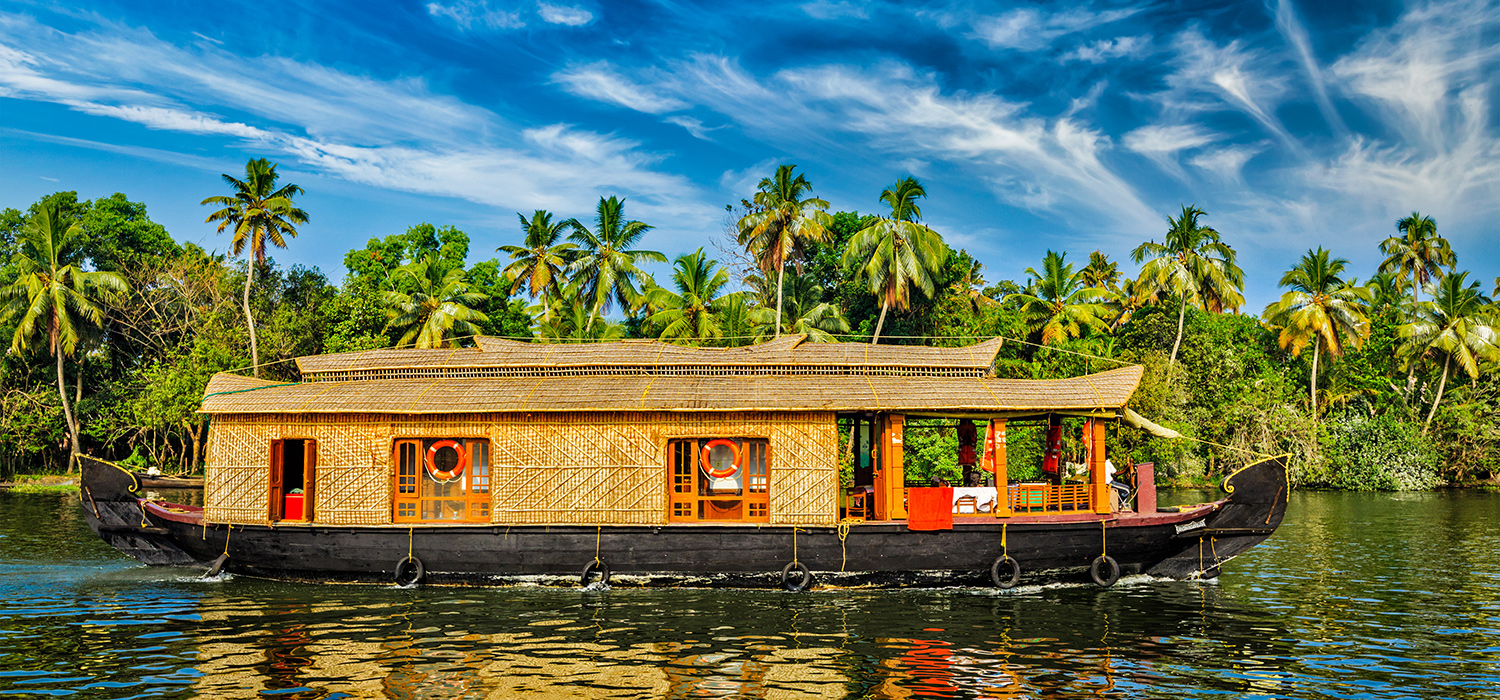
Lunch, Dinner and Overnight on Houseboat.
Day 10: Backwaters / Cochin (Approx. 53 Kms / 01 ½ Hrs)
After breakfast, disembark the houseboat and drive to Cochin by Surface.
COCHIN – Cochin has long been eulogized in tourist literature as the ‘Queen of the Arabian Sea’. Its location between the blue waters of the Arabian Sea and Kerala’s emerald backwaters, its rich medley of Indian and foreign architecture, it’s truly unusual sights like the Chinese fishing nets and its quaint quiet localities like the Jewish Quarters demand the attention of all who travel to Kerala. Set on a cluster of islands and a peninsula, Cochin (now, Kochi) is a blend of medieval Portugal, Holland and an English country village. Cochin remained incomplete in terms of success till the arrival of the Portuguese. It is believed that the Cochin district came into existence in the year 1102 AD after the breakup of the Khulasekhara Empire.
On arrival in Cochin, transfer to the hotel.
Overnight at the hotel
Day 11: Madurai / Periyar (142 Kms around 04½ hrs drive)
After breakfast, enjoy a nice walk around Fort Cochin area – This walking tour gives you a glimpse into Cochin’s rich history and heritage, showcasing the mixed Dutch, Portuguese, and British and Jewish influences that make the city unique. During the tour, we will visit the old quarter of Fort Kochi, exploring the quaint streets of this city on foot. We will also visit Fort Kochi’s seaside promenade, and get a glimpse of daily life in Kochi. The duration of the walk will be around 02 Hours. We will start the tour from St. Francis Church: It is the oldest church built by Europeans in India. On his 3rd visit to Kerala, Vasco da Gama, the Portuguese trader who reached India from Europe by sea, fell ill and died in Kochi. He was buried in the St. Francis Church. Later his remains were taken back to Portugal. In spite of that, his burial spot inside the church has been clearly marked out. Spend around 30 Minutes here. After a short walk reach at Santa Cruz Basilica – This is Roman Catholic Church with beautiful paintings on the ceiling, continue the walk and visit Dutch Cemetry close to St Francis Church. Continue your walk after 10 minutes’ walk reach at Chinese Fishing nets (Cheenavala) are distinctly unique to Cochin. It is believed that traders from the court of the Chinese ruler Kublai Khan introduced these nets here. Oddly, these nets are found only in Kochi, outside China! Many fishermen earn their livelihood by fishing using these massive nets. A whole stretch of the coast along Fort Kochi and Vypeen are dotted with these nets.
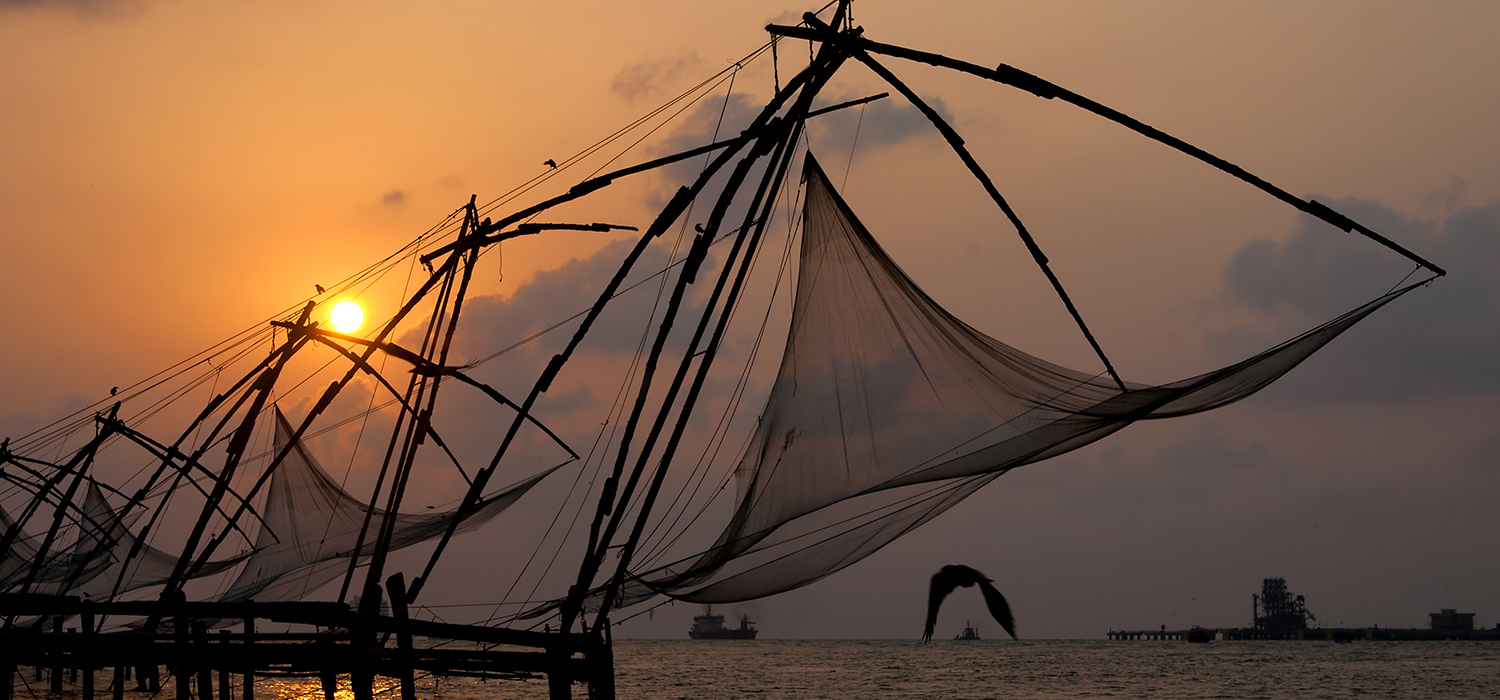
Also visit the Dutch Palace – The Dutch Palace was originally built by the Portuguese. Later, in 17th century, the Dutch modified it and presented it to the Raja of Kochi. Coronation of many Rajas of Kochi was held here. The palace has a fine collection of mural paintings depicting scenes from the Hindu epics Mahabharatha and Ramayana. The palace is located in Mattancherry. IMP: It remains closed on Fridays and saturdays. Timings for the visit: 1000 hrs to 1700 hrs.
Jewish Synagogue – The synagogue, built in 1568, is magnificently decorated by Chinese tiles and Belgian chandeliers. Giant scrolls of the Old Testament can be found here. It is located near the Dutch Palace in Mattancherry. IMP: It remains closed on Friday (In 2nd half of the day, after 01 PM), Saturday and on Jewish Holidays. Timings for the visit: 0900 hrs to 1200 hrs and from 1500 hrs to 1700 hrs.
Evening, enjoy a Kathakali dance drama (Public theatre) – A special treat awaits us this evening as we proceed to witness the strength and vigor of Kathakali dance drama, as it enacts episodes from great Indian epics. The extremely stylized gestures, the elaborate make-up, the masks and the splendid costumes of these all-male dancers, recreates an incomparable sense of pageantry.
Overnight at the hotel
Day 12: Cochin Departure
After breakfast, in time transfer to the Cochin international Airport for taking flight back home / onward destination.
(Room will be available till 1200 Hrs only)
End of Services
Day |
City |
Hotels |
||
|
|
Accommodation |
Room Type |
Meals |
|
| Day 01 | Arrive in Chennai | The Leela Palace | Deluxe Room City View | –/–/– |
| Day 02 | Chennai / Mahabalipuram / Pondicherry | Palais de Mahe | Palais Chambre Deluxe | B/–/– |
| Day 03 | Pondicherry | Palais de Mahe | Palais Chambre Deluxe | B/–/– |
| Day 04 | Pondicherry / Kumbakonam | Mantra Koodam | Mantra Cottage | B/–/– |
| Day 05 | Kumbakonam | Mantra Koodam | Mantra Cottage | B/–/– |
| Day 06 | Kumbakonam / Thanjavur / Trichy/ Madurai | Gateway Madurai | Colonial Room | B/–/– |
| Day 07 | Madurai | Gateway Madurai | Colonial Room | B/–/– |
| Day 08 | Madurai / Periyar | Spice Village | Spice Garden Cottage | B/–/– |
| Day 09 | Periyar/ Backwaters | Houseboat | Standard | B/L/D |
| Day 10 | Backwaters/ Cochin | Brunton Boatyard | Sea Facing | B/–/– |
| Day 11 | Cochin | Brunton Boatyard | Sea Facing | B/–/– |
| Day 12 | Cochin Departure |
*Breakfast | Lunch | Dinner
Price Details
Prices are valid from 01st October 2026 till 19th December 2026 & 10th Jan, 2027 till 15 April 2027
2 Pax Price USD 3199 Per Person sharing a Double room
Cost Includes
* Double / Twin room on sharing basis
* Daily Breakfast. 01 Lunch and 01 dinner during day on houseboat
* TRANSPORTATION: All ground transportation, as detailed in the itinerary using AC Vehicle as given below:
• AC Toyota Innova up to 03 pax
• AC Tempo from 04 -06 Pax.
* Services of local English-Speaking Guide for Sightseeing only (Different Guide for each destination)..
* Following activities/ experience included:
• Heritage walk in French quarters of Pondicherry
• Enjoy bullock cart through villages in Kumbakonam
• Walking tour in Madurai
• Scenic jeep ride tour in Periyar
• Kalarippayattu Performance in Periyar
• Kathakali dance performance in Cochin
* Monument entrance fee as per the program.
* Currently applicable taxes
Cost does not include
X Any airfares.
X Any airport taxes.
X Any expenditure of personal nature such as drinks, tips, laundry, telephone charges etc.
X Any meals other than specified
X Any new tax imposed by the Govt.
Booking & Payment Procedure:
25% of the ticket value is required as an advance payment at the time of booking.
The balance payment must be made 60 days prior to the departure date.
Cancellation Rules:
10% of the ticket value will be deducted for cancellations made 120 to 90 days before the travel date.
25% of the ticket value will be deducted for cancellations made 89 to 60 days before the travel date.
50% of the ticket value will be deducted for cancellations made 59 to 30 days before the travel date.
No refund is available for cancellations made within 29 days of the departure date.



